
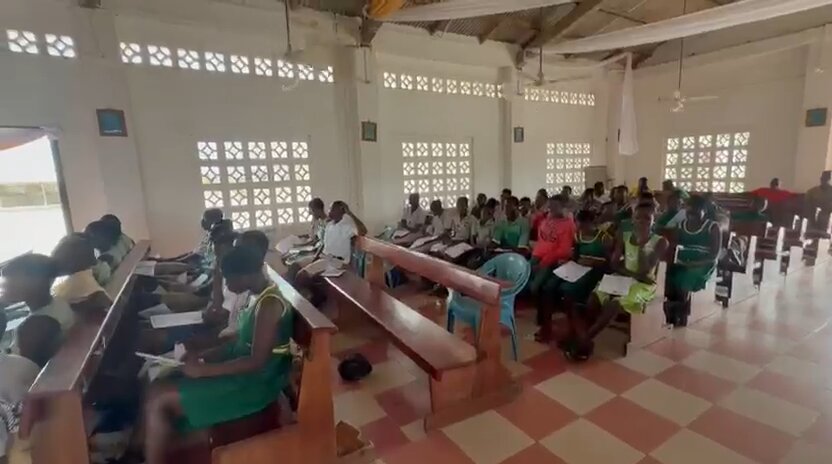

A significant stride towards educational advancement is underway in the Keta municipality, specifically within the community of Atiavi. The recent introduction of practical science lessons marks a pivotal moment, transforming theoretical learning into an engaging, hands-on experience for students. This initiative aims to bridge the gap between textbook knowledge and real-world application, fostering a deeper understanding and appreciation for scientific principles among young learners.
Transforming Learning Through Hands-On Experience
For too long, science education in many rural areas has been limited by a lack of access to proper laboratory equipment and practical demonstrations. The introduction of science practicals at Atiavi is set to change this narrative entirely. Students will now have the opportunity to conduct experiments, observe phenomena firsthand, and develop critical thinking and problem-solving skills that are essential for scientific inquiry.
Building a Foundation for STEM Careers
This initiative is not merely about improving grades; it's about igniting a passion for Science, Technology, Engineering, and Mathematics (STEM) fields. By allowing students to actively participate in experiments, they can visualize complex concepts, understand methodologies, and even discover a potential career path. Imagine the excitement of a student seeing a chemical reaction unfold or understanding the principles of electricity through a simple circuit they built themselves.
Community Impact and Future Prospects
The success of the science practical introduction at Atiavi in the Keta municipality hinges on sustained support and resources. This foundational step has the potential to cultivate a generation of innovators and problem-solvers who can contribute significantly to their community and the nation. It's an investment in intellectual capital, promising a brighter future where local challenges might find local, scientifically informed solutions, fostering a spirit of inquiry and discovery that extends far beyond the classroom walls.